Smart buildings and BACS
BACS stands for Building Automation and Control System. This is an intelligent software and hardware system that automatically monitors, analyzes, regulates, and supervises technical installations (such as heating, cooling, ventilation, lighting, and solar shading) in buildings.

Regulations make building automation increasingly important
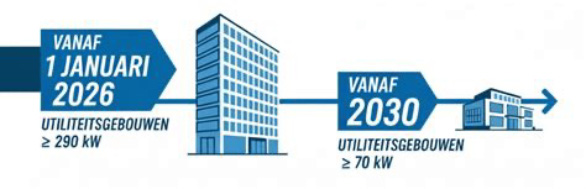
As of January 1, 2026, a BACS obligation will already apply in the Netherlands for certain non-residential buildings with heating or air conditioning systems exceeding the relevant power threshold of 290 kW. The Netherlands Enterprise Agency (RVO) describes BACS as a system that reads and controls climate and energy installations.
A BACS must be capable of, among other things:
- permanently monitoring, recording, and analyzing energy use;
- enabling the adjustment of energy consumption;
- assessing the energy efficiency of the building;
- detecting efficiency losses in technical building systems;
- making information about improvement opportunities available;
- communicating with connected technical building systems;
- interoperating with other technical systems that influence energy use.
The tightened EPBD IV rules expand this further. The Dutch government indicates that as of January 1, 2030, BACS requirements will also apply to medium-sized non-residential buildings with systems exceeding the new threshold of 70 kW. Functions are also being added regarding the monitoring and control of indoor environmental quality, including temperature and ventilation, and the automatic control of lighting in non-residential buildings.
This is therefore broader than just measuring energy.
It is increasingly about measuring → analyzing → communicating → controlling → optimizing.
Thinq as the foundation for a BACS-ready building
Thinq brings together several relevant building blocks:
- Fine-grained wireless infrastructure
The Wirepas mesh network uses Thinq nodes as a distributed communication infrastructure throughout the building. - Real-time information from the space
MIRA provides insight into occupancy, people counting, temperature, air quality, CO₂, humidity, air pressure, and sound. - Integration with HVAC
Measurement data can be exchanged with BMS and HVAC components via standard interfaces. - Lighting and climate from the same building data
Presence and space utilization can therefore be relevant not only for lighting but also for ventilation, heating, and cooling. - Data available for dashboards
For visualization and further analysis, building data can additionally be linked to a platform such as Next Sense.
